

Humidity was one of the hardest storage variables for me to get right, not because I did not understand the numbers, but because real homes rarely stay stable. Even when I knew the ideal humidity range for vinyl, seasonal swings, weather changes, and HVAC cycles made consistency difficult. What I noticed first was not warped records or mold. It was static, dust attraction, and handling friction that suddenly felt harder to control.
During dry months, records clung to sleeves and mats. In more humid periods, dust seemed to settle more easily and surfaces felt grimy faster. None of this meant the records were being damaged immediately, but it was a sign that the environment was working against long-term care. Static and dust were symptoms of humidity drifting outside a comfortable range, even when the change was subtle.
What helped was reframing humidity control as a layered strategy. Direct humidity tools like dehumidifiers and humidity packs matter, but they are not always precise or convenient in everyday living spaces. Static control, surface grounding, and careful cleaning reduce the stress that humidity swings place on records and playback equipment. They do not replace true humidity control, but they make storage and handling more forgiving when conditions are imperfect.
This guide is written for collectors who want practical ways to manage humidity-related problems without pretending that every room can be perfectly climate controlled. The tools here help reduce static buildup, limit dust attraction, and stabilize handling conditions, which all support vinyl longevity when used alongside good storage habits. Humidity control works best when it is supported by small, thoughtful interventions rather than a single fix.
Quick Recommendations
If you are dealing with humidity swings that show up as static, dust attraction, or inconsistent handling, these tools help reduce stress on records and playback equipment. Each option below addresses a specific part of environmental control, supporting vinyl storage when perfect humidity is hard to maintain.
Best Overall Static Control Tool for Humidity-Prone Environments | HumminGuru Orbit Vinyl Record Static Remover
A hands-off solution that reduces static buildup caused by dry air and humidity fluctuations. Useful when static becomes persistent despite good storage habits.
Best Manual Anti-Static Tool | Milty Zerostat 3 Anti-Static Gun
A targeted tool for neutralizing static charge during handling and playback, especially effective during dry seasons.
Best Turntable-Level Static Reduction | Reoflyup Silicone Anti-Static Vinyl Record Pad
Helps reduce static transfer between record and platter, supporting more consistent handling in variable humidity.
Best Stable Turntable Mat for Environmental Consistency | PRO SPIN White Acrylic Turntable Mat
Provides a stable, non-porous surface that resists static buildup and does not trap moisture the way some mats can.
Best Supporting Cleaning Kit for Environmental Care | Boundless Audio Vinyl Record Cleaning Kit (8-in-1)
A practical set of tools for managing dust and surface contamination that become more common when humidity is inconsistent.
Buyer Education: Managing Humidity and Static Together
Humidity affects vinyl in indirect ways long before it causes obvious damage. Most collectors think of humidity in terms of warping or mold, but the more common day-to-day issues are static buildup, dust attraction, and inconsistent handling. These problems tend to appear when humidity drifts outside a stable middle range, even if it does not stay there long enough to cause visible damage.
Why Humidity and Static Are Connected
Dry air increases static charge. When humidity drops, records and sleeves lose the small amount of moisture that helps dissipate electrical charge. As a result, records cling to inner sleeves, attract airborne dust, and resist clean handling. In higher humidity, static may be less noticeable, but dust and surface contamination can increase, especially if airflow is poor.
Understanding Ideal Humidity Levels for Vinyl Records and Turntables helps explain why these issues tend to cluster together. When humidity stays within a moderate range, static and dust problems are easier to control. When it does not, secondary tools become more important.
What Static Tools Do and Do Not Solve
Static control tools do not change humidity. They do not add or remove moisture from the air, and they do not stabilize room conditions on their own. What they do is neutralize electrical charge, reduce friction during handling, and limit how much dust clings to record surfaces when humidity is imperfect.
This makes them useful in real homes where humidity fluctuates despite best efforts. They are best viewed as mitigation tools that reduce stress on records rather than primary environmental controls.
Layering Environmental Controls
Direct humidity control still matters. Dehumidifiers, humidity packs, and climate-aware storage choices do the heavy lifting when it comes to keeping records safe. Using Dehumidifiers and Humidity Packs for Vinyl Storage explains how those tools work and where they are most effective.
Static control, surface grounding, and careful cleaning layer on top of those efforts. Together, they create a more forgiving environment where short-term humidity swings do not immediately translate into handling problems or dust buildup.
Storage Location Matters More Than Tools
No static or cleaning tool can fully compensate for a poor storage location. Basements and attics often experience the widest humidity swings and the least airflow, which increases both static and dust problems. Are Basements or Attics Safe for Vinyl Record Storage? outlines why these spaces pose risks even when records are boxed or sleeved.
The most effective approach is choosing the best storage location first, then using static control and cleaning tools to manage the remaining variables. When humidity control and static mitigation work together, records are easier to handle, stay cleaner, and age more predictably over time.
Product Reviews: Anti‑Static Vinyl Record Accessories
Best Overall Static Control Tool for Humidity-Prone Environments
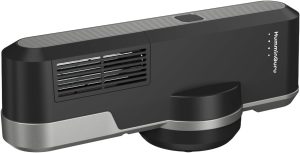
The HumminGuru Orbit is best understood as a convenience-focused static mitigation tool rather than a traditional cleaning accessory. Its role is to neutralize static charge at the moment it becomes disruptive, which is especially helpful in environments where humidity fluctuates seasonally and static shows up unpredictably.
Static caused by dry air or rapid humidity drops tends to manifest during handling. Records cling to sleeves, mats hold charge, and dust becomes harder to control. The Orbit addresses this by reducing surface charge without requiring physical contact or fluid. That low-contact approach matters because static problems often tempt people into over-handling records, which introduces its own risks.
In practical use, the Orbit fits naturally into a playback routine. It can be used just before playing a record or during handling when static is noticeable. Because it does not rely on brushing or wiping, it avoids dragging particles across the record surface. This makes it a safer choice when static is the primary issue rather than visible grime.
It is important to be clear about what this tool does not do. It does not change humidity levels, and it does not prevent static from returning if environmental conditions remain dry. Its value lies in reducing the immediate effects of static so that handling remains controlled and dust attraction is minimized while broader humidity strategies do their work.
The HumminGuru Orbit is best for collectors who already store records thoughtfully but still experience static during certain seasons or weather patterns. Used as part of a layered environmental approach, it reduces friction, limits dust attraction, and makes playback more predictable without adding unnecessary handling or complexity.
Best Manual Anti-Static Tool
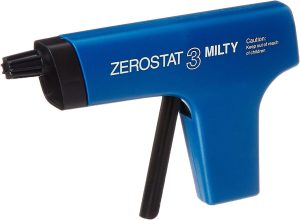
The Milty Zerostat 3 is one of the most well-known static mitigation tools among collectors because it provides a simple, targeted way to neutralize charge without touching the record surface. Rather than acting as a humidity controller, it directly addresses one of the most obvious downstream effects of low humidity: static cling that attracts dust and interferes with clean handling.
This tool works by generating ions that neutralize static charge when the trigger is squeezed. Because it does not rely on physical contact with vinyl or sleeves, it reduces the common problem of brushing or wiping static into the grooves. That can be especially helpful when humidity drops, air becomes dry, and static becomes persistent during handling or playback.
One of the strengths of the Zerostat 3 is how quickly it works. In many homes, static buildup is intermittent and unpredictable, appearing during certain weather or HVAC cycles. The gun lets you address that charge right when it happens without having to reach for cleaning fluids or elaborate tools. This makes it a natural fit in routines where humidity is inconsistent and static problems show up despite good sleeve choices, sleeve hygiene, and dust control.
It is worth noting that this tool does not solve humidity itself. Static will return if the environment remains dry. The Zerostat 3 simply reduces the immediate effects so you can handle records without clinging sleeves and dust attraction. When static is neutralized, dust and airborne particles are less likely to adhere to surfaces, which indirectly supports cleaner playback and reduces the frequency with which you might feel the need to clean.
The Milty Zerostat 3 is best for collectors who want a quick, low-contact way to neutralize static as conditions change. It works well alongside direct humidity control methods and other environmental strategies that aim to make storage and handling more stable and predictable.
Best Turntable-Level Static Reduction
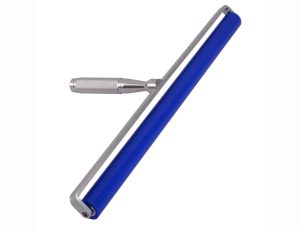
Static problems often show up right at the interface between the record and the turntable platter, especially when humidity is low or air quality is imperfect. A silicone anti-static record pad like this one from Reoflyup does not control room humidity, but it helps reduce static at the point of contact, which lowers dust attraction and makes handling more predictable.
This pad is designed to replace or sit between your current turntable mat and the vinyl itself, providing a non-porous, low-charge interface. Because it does not trap moisture or fibers the way some felt or cork mats can, it minimizes the surface where static buildup commonly occurs. As a result, the record is less likely to cling, attract airborne debris, or require frequent additional brushing.
Reducing static at the platter level has practical benefits for both handling and playback. When static charge is lower, dust is less likely to adhere tightly to the surface, which in turn reduces the need for dry brushing or fluid cleaning before play. That may not solve humidity drift, but it reduces the consequences of imperfect humidity on day-to-day playback.
One of the strengths of this kind of pad is its stability and simplicity. It sits flat, does not require additional tools or power, and stays in place during normal use. That stability matters because any movement or shifting during playback can itself generate charge or attract dust.
This pad is best for collectors who experience static cling or dust attraction that seems most pronounced when a record spins or when it is placed on the platter. Used alongside humidity-aware storage and other static mitigation tools, it helps make the playback surface more predictable and lowers the strain that static buildup places on both record surfaces and stylus contact.
Best Stable Turntable Mat for Environmental Consistency

While humidity and static are often discussed in terms of air quality and shelving conditions, the turntable mat itself plays a subtle role in how environmental variables affect playback. A stable, non-porous mat like the PRO SPIN White Acrylic Turntable Mat does not change humidity, but it provides a uniform surface that resists static buildup and does not trap moisture the way some cloth or felt mats can. That makes it easier to keep records grounded and reduces dust attraction during playback.
The acrylic surface offers a consistent electrical environment between the platter and the record, which helps dissipate charge rather than letting it accumulate under the record edge. This matters in homes where humidity fluctuates because the mat is part of the most frequent contact point between vinyl and hardware. When static charge is lower at this interface, dust is less likely to cling, and removal with a simple dry brush becomes more effective.
Another practical benefit of acrylic mats is their resistance to moisture absorption. Felt, cork, and rubber alternatives can hold tiny amounts of humidity or oils, which can change how static behaves over time. Acrylic, by contrast, remains unaffected by small humidity variations in day-to-day use, making playback more predictable and reducing one of the common variables that encourage unnecessary handling.
This mat also provides a smooth, well-leveled surface that supports consistent rotation and lowers the risk of surface chatter. That stability is especially helpful in collections where records are played frequently and the player’s environment isn’t perfectly climate controlled.
The PRO SPIN White Acrylic Turntable Mat is best for collectors who want a more stable playback foundation that indirectly supports humidity and static management. Used alongside direct humidity control and other static mitigation tools, it helps make playback less prone to environmental quirks without introducing its own variables.
Best Supporting Cleaning Kit for Environmental Care
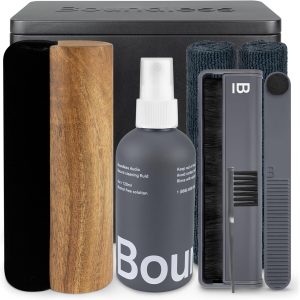
A thorough cleaning routine supports humidity control by reducing the debris that static and humidity swings tend to attract. When humidity changes, airborne dust and tiny particles settle more easily onto record surfaces. Left unchecked, that debris becomes harder to remove and increases the chance that handling or playback will push particles deeper into grooves. A comprehensive kit like the Boundless Audio 8-in-1 helps manage those contaminants before they become a bigger problem.
This kit brings together the basic tools most collectors need for controlled, low-risk cleaning. It typically includes brushes for dry dust removal, fluid for occasional wet cleaning, and pads that work well with light contamination. That range of tools means you can remove dust before it has the chance to accumulate and interact with static charge or humidity-related buildup.
One of the key benefits of a kit like this is accessibility. Vinyl care routines can feel overwhelming when each task requires a separate tool or technique. A well-rounded kit makes it easier to integrate cleaning into a broader environmental care strategy without adding complexity. When dust is removed regularly and gently with the right tools, static issues tend to be less intense, and playback is smoother.
It is important to use these tools with restraint. Dry brushes before playback often prevent the need for wet cleaning later, and fluid-based methods should be reserved for records with visible residue that dry tools cannot handle. Overcleaning does not help and can expose records to unnecessary handling stress or moisture.
The Boundless Audio Vinyl Record Cleaning Kit (8-in-1) is best for collectors who want an all-in-one set of tools that help manage debris in variable environments. Combined with static mitigation and humidity-aware storage habits, it supports a more stable, worry-free listening experience.
Final Thoughts
Humidity control is the foundation of long-term vinyl storage. Static buildup, dust attraction, and handling frustration are often the first signs that environmental conditions are drifting outside a comfortable range. While none of the tools here change humidity on their own, they are practical parts of a layered strategy that helps adapt your care routine to real-world conditions.
Direct humidity control through dehumidifiers, humidity packs, and careful location choices remains the most effective way to stabilize storage conditions. Static neutralizers reduce immediate charge during handling. Anti-static mats and pads help keep playback interfaces consistent. Cleaning tools reduce the debris that humidity swings tend to make more apparent.
Used together, these tools support a more predictable environment where records are easier to handle and dust is less likely to accumulate. Humidity control is not about perfection. It is about minimizing extremes and creating stable conditions where preservation habits matter more than discomfort.